A migration safari can look expensive until you understand what the money actually pays for.
The kenya migration safari cost is not one thing. It covers park entry, guide time, vehicle access, fuel, camp location, conservancy fees, meals, airstrip transfers, and the knowledge to be in the right place when the wildebeest move. During the Great Migration, that last factor matters more than almost anything else. A cheap camp two hours from the Mara River does not save money when the herds are crossing at dawn.
This guide breaks down the real cost of a Masai Mara migration safari, explains what changes the price, where you can make smart savings, and where saving too much quietly damages the experience.
Quick Cost Snapshot
These ranges are planning estimates, not fixed quotes. Migration rates shift by camp, date, room availability, vehicle type, and flight schedule. Use them to understand the shape of your budget before requesting a tailored quote.
| Safari Style | Typical Per Person Range | Best For | Main Trade-Off |
|---|---|---|---|
| Budget migration safari | USD 1,200-2,000 for 3-4 days | Cost-aware travellers | Longer drives, simpler camps |
| Mid-range migration safari | USD 2,000-4,500 for 4-6 days | First-time guests | Good comfort, controlled cost |
| Luxury migration safari | USD 4,500-9,000+ for 5-7 days | Honeymooners, photographers | Higher camp and flight costs |
| Private custom safari | Quote-based | Families and private groups | Best flexibility, higher vehicle cost |
The great migration safari price Kenya rises sharply from July to October because demand is concentrated in a short season. August is usually the most expensive month. September often gives better value while still delivering strong migration activity and river crossings.
What Drives Kenya Migration Safari Cost
Park and Conservancy Fees
Masai Mara entry fees represent one of the largest fixed costs in any migration safari budget. Non-resident adult entry for the public reserve runs USD 100 per day from January through June and USD 200 per day from July through December, with children aged 9-17 at USD 50 per day. These are 2026 figures based on publicly available guidance from conservation management bodies — confirm current rates before finalising any booking, as county and conservancy structures change periodically.
For guests staying outside the reserve boundary, ticket timing also affects the real cost. A lower room rate outside the reserve may look attractive, but daily entry fees combined with longer drive times to the crossing zones can quickly close that gap.
Camp Location
Camp position is the price factor most travellers underestimate. A camp close to active crossing zones or within a strong private conservancy costs more per night, but it saves time, fuel, and energy every single day.
A cheaper camp placed far from active herd areas creates hidden costs you do not see in the quoted price:
- More fuel burned reaching prime sightings
- Later arrivals at crossing points — often after the first movement of the morning
- Less rest between game drives
- Higher chance of missing fast-moving river activity as herds shift zones
- More crowded sightings if the camp depends entirely on reserve access
This is why camp selection for a migration safari should start with field position, not room rate.
Vehicle and Guide Setup
A shared vehicle reduces the masai mara safari cost migration figure on paper. A private vehicle costs more, but gives your group full control over timing, patience, and photography positioning — particularly at the river.
Private vehicles make the clearest difference for:
- Photographers who need light and angle control at crossing points
- Families with children who may need breaks or pace adjustments
- Honeymooners who want privacy during sightings
- Guests who prefer to hold position at one crossing location for extended periods
- Anyone who finds shared group schedules restrictive during peak migration drama
Guide quality deserves equal attention. During migration season, a guide reads herd behaviour, vehicle movement, water level changes, and time pressure simultaneously. The difference between a guide with five Mara seasons and one with one season is measurable in crossing opportunities.
Budget vs Mid-Range vs Luxury
Budget Migration Safaris
A budget safari Kenya price migration plan typically uses road transfers from Nairobi, simpler camps inside the reserve, and shared game drive vehicles. This can work well when the trade-offs are understood honestly.
Budget migration safaris work best when:
- You travel in early July, September, or October rather than peak August
- You stay at least 3-4 nights to allow for the unpredictability of crossing timing
- You choose a clean, well-run camp with reasonable access to the Mara River corridor
- The wildlife experience matters more to you than accommodation quality
Budget becomes a risk when it places you too far from the river, relies on rushed morning drives, or packages a “migration safari” that spends the majority of vehicle time commuting between distant sighting areas.
Mid-Range Migration Safaris
Mid-range represents the strongest value point for most guests. Better camp positioning, reliable private or semi-private vehicles, stronger guiding credentials, and enough comfort to rest properly between long game drives are the standard at this tier.
For many Kenya safari itineraries, this is where the experience finds its balance. You are not paying for luxury branding, but you are not cutting the components that actually make a migration safari work.
Luxury Migration Safaris
A luxury safari Kenya cost migration budget buys location, privacy, food quality, camp design, guide depth, and seamless logistics. This tier typically includes fly-in charter transfers, private conservancy camps such as Mara North, Olare Motorogi, or Naboisho, a private 4WD vehicle dedicated to your group, off-road driving, night drives, all meals and beverages, and in some cases hot air balloon flights.
In the Mara, luxury often means access more than softness. Fewer vehicles at sightings, better angles, flexible departure timing, and camps that can respond quickly when the herds shift position overnight.
Sample Cost Structure by Trip Length
| Trip Length | Practical Budget | Notes |
|---|---|---|
| 3 days / 2 nights | USD 1,200-2,500 pp | Works with careful timing and efficient access |
| 4 days / 3 nights | USD 1,800-3,800 pp | Better probability of witnessing a river crossing |
| 5 days / 4 nights | USD 2,500-5,500 pp | Strong balance for most travellers |
| 7 days / 6 nights | USD 4,000-9,000+ pp | Best for photographers and those who prefer a slower pace |
The kenya safari daily cost migration estimate can look high because migration season compresses demand. The best camps have limited rooms and experienced guides book out months in advance.
Hidden Costs to Ask About Before Paying
Before accepting any quote, confirm whether these items are included:
- Park or conservancy fees
- Airstrip transfers
- Domestic charter flights
- Vehicle entry fees at park gates
- Private vehicle supplement
- Soft and premium drinks
- Laundry
- Maasai village visit fees
- Hot air balloon safari
- Gratuities for guides and camp staff
- Single supplement
- Travel insurance
Some migration safari deals Kenya listings appear competitive because they omit fees that surface later at the camp gate or on checkout. Ask for a fully loaded number before you commit.
How to Reduce Cost Without Weakening the Safari
You can reduce the price intelligently without compromising the core experience:
- Travel in September rather than August for lower rates and still-strong crossing activity
- Use road transfer one way and fly one way to split the cost
- Choose a strong mid-range camp over a famous luxury name if the field location is comparable
- Share the vehicle if your group is small and comfortable with a shared schedule
- Book early, before the best-value rooms are taken by repeat clients and early planners
- Keep the itinerary focused on the Mara rather than adding too many parks across a short trip
The one saving that tends to backfire: cutting the number of nights too far. A 2-night migration safari can technically deliver a crossing sighting, but it leaves almost no room for weather, herd movement delays, or the natural rhythm of settling into the bush. Three nights is the honest minimum.
Explorer Notes
A few things that experienced migration travellers wish they had known earlier:
- The Mara River has about a dozen crossing points. Guides choose based on herd position, water level, and vehicle traffic. If you are in a private vehicle, your guide can shift position mid-morning. In a shared vehicle, that flexibility disappears.
- Rain in August is rare but not impossible. A brief afternoon storm clears quickly, and the light afterward is outstanding. Do not let a cloudy morning forecast change your drive plans.
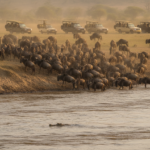
- Wildebeest cross and re-cross. Animals that moved south one day may be back north a week later. A longer stay gives you multiple opportunities and removes the pressure of pinning everything on one morning.
- September is genuinely underrated. Herd numbers are still strong, light aircraft prices are lower, and the push of school-holiday travellers has eased. For photographers especially, September mornings are exceptional.
Conclusion
The kenya migration safari cost question does not have one answer, but it does have a clear framework. Park fees are fixed and non-negotiable. Camp location and vehicle exclusivity are the two variables that most determine what you see and how you see it. Time in the Mara matters more than any single night’s accommodation standard.
A 5-night migration safari in a mid-range to upper-mid camp, with a private vehicle and a guide who has worked the river for multiple seasons, will deliver more than a 3-night luxury camp stay with a shared vehicle. The numbers are different; the experience gap is wider.
Next Steps
If you are planning a 2026 migration safari, the most useful next step is to map your travel dates against the crossing window, confirm your accommodation budget, and check availability at the camps with the strongest field positions. Popular camps in Mara North and Olare Motorogi fill by January for peak August dates.
For a comparison of multi-park Kenya circuits against single-park deep-dives, see our guide at touringinsights.com. For a closer look at rhino conservation itineraries that can pair with a Mara migration trip, our Kenya rhino sanctuaries guide covers the main Laikipia options.
External reference: Mara Reserve conservation and fee updates and Save the Rhino Kenya programme data.
Have questions about this itinerary or destination? Get answers from a safari specialist before you commit.
Inquire MoreFurther reading
- Maasai Mara Wildlife Conservancies Association
- Magical Kenya (Kenya Tourism Board)
- African Wildlife Foundation